Understanding Social Anxiety
Social anxiety disorder—also known as social phobia—is one of the most common mental health conditions in Australia, with research indicating a lifetime prevalence of around 8-9% and a 12-month prevalence of approximately 4-5% in the Australian community. Yet it often goes unrecognised, dismissed as "just being shy" or a personality trait rather than a treatable condition.
This comprehensive guide covers everything you need to understand about social anxiety: what it is, why people have social anxiety, how it's maintained, and most importantly, what works to overcome it.
If you think you have social anxiety or have ever wondered "do I have social anxiety?", this guide will help you understand the condition and your options.
What Is Social Anxiety Disorder?
Social anxiety disorder involves intense fear of social situations where you might be scrutinised or judged by others. The social fear leads to significant distress and often to avoidance of the situations that trigger it.
The core fear is negative evaluation—that others will think badly of you, see your flaws, judge you as inadequate, or reject you. This fear of social anxiety-triggering situations can generalise from specific contexts to pervade almost all social interaction.
How To Tell If You Have Social Anxiety
Many people wonder "how do I know if I have social anxiety?" or ask themselves "how to know if you have social anxiety?" The key indicators are:
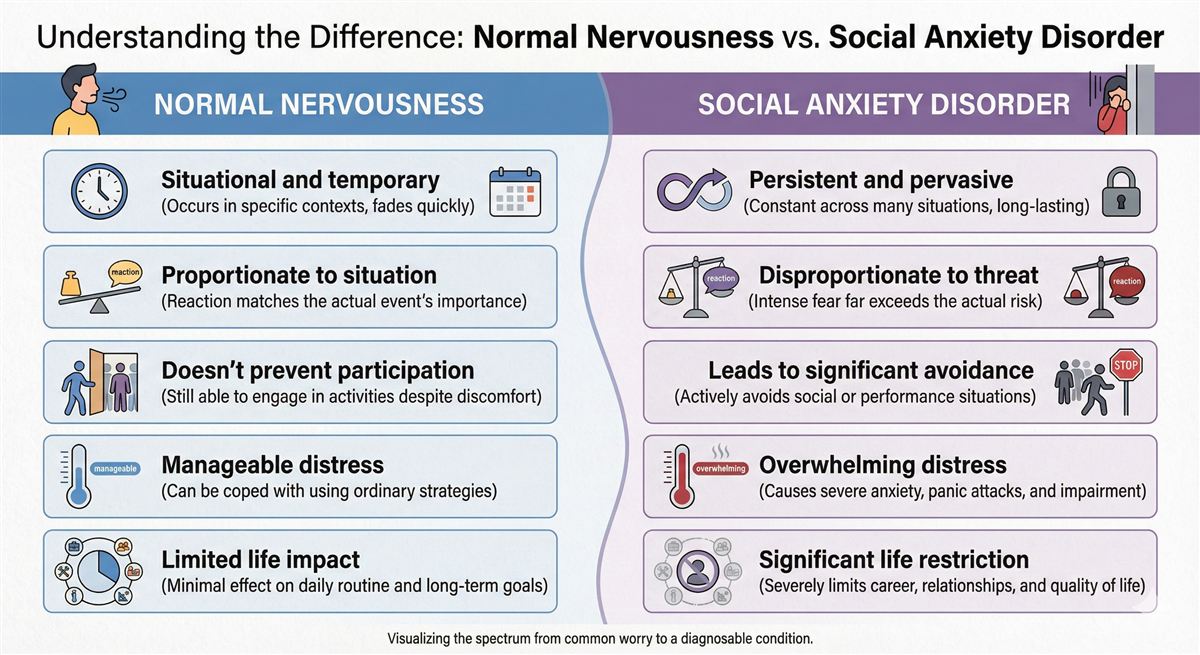
- Disproportionate fear: Your anxiety is out of proportion to the actual social threat
- Avoidance pattern: You regularly avoid social situations or endure them with significant distress
- Life interference: Social anxiety affects your work, relationships, education, or daily activities
- Duration: The pattern has persisted for six months or more
- Not explained by other factors: The anxiety isn't due to medication, substances, or other conditions
If you're asking "how to tell if I have social anxiety," consider whether these patterns apply to you consistently across situations.
DSM-5 Criteria for Social Anxiety
The DSM-5 criteria for social anxiety disorder formally require:
- Marked fear or anxiety about one or more social situations
- Fear of acting in ways that will lead to negative evaluation
- Social situations almost always provoke fear or anxiety
- Social situations are avoided or endured with intense fear
- Fear is disproportionate to the actual threat
- Fear, anxiety, or avoidance is persistent (typically 6+ months)
- Causes clinically significant distress or impairment
- Not attributable to other conditions or substances
Social Anxiety vs Normal Nervousness
Signs and Symptoms of Social Anxiety
Signs of Social Phobia: The Core Pattern
The signs and symptoms of social phobia typically include fear, physical symptoms, cognitive symptoms, and avoidance behaviour. Understanding these signs of social phobia helps with recognition and treatment.
Physical Symptoms of Social Anxiety
Social anxiety attack symptoms and general social phobia symptoms include:
Visible symptoms (often feared in themselves):
- Blushing or facial flushing
- Sweating and trembling
- Voice shaking or going blank
- Visible shaking or trembling anxiety
- Appearing awkward or self-conscious
Internal symptoms:
- Racing heart (even when not doing anything physically demanding)
- Nausea, stomach upset, or diarrhoea
- Dry mouth and difficulty swallowing
- Feeling hot or having hot flashes
- Dizziness, lightheadedness, or feeling faint
- Muscle tension and body aches
- Shortness of breath
Many people with social phobia fear these physical symptoms being noticed by others, creating a secondary layer of anxiety. You fear blushing, which makes you more likely to blush, which increases the fear.
Cognitive Symptoms
Social anxiety involves characteristic thinking patterns:
Before social situations:
- Negative predictions: "I'll embarrass myself"
- Mind-reading: "They'll think I'm boring"
- Catastrophising: "If I mess up, it will be a disaster"
- Fear of judgment: "Everyone will see how anxious I am"
- Fear of rejection: "They won't like me"
During social situations:
- Self-conscious focus: monitoring your own anxiety, performance, appearance
- Hypervigilance for signs of disapproval
- Difficulty concentrating on the conversation
- Mental blanks
After social situations:
- Post-event rumination: replaying what happened, focusing on perceived failures
- Selective memory for negative aspects
- Discounting positive feedback
Behavioural Symptoms
The behavioural hallmark of social phobia is avoidance:
Complete avoidance:
- Not attending events, parties, or gatherings
- Avoiding social situations entirely
- Not applying for jobs or opportunities
- Skipping classes or meetings
- Declining invitations
Partial avoidance:
- Arriving late and leaving early
- Staying on the periphery
- Avoiding speaking up
- Not initiating conversations
- Using phones as social shields
Safety behaviours (actions taken to manage anxiety that often maintain it):
- Over-rehearsing what to say
- Avoiding eye contact
- Speaking quietly or quickly
- Using alcohol to cope
- Only attending with a "safe" person
The Spectrum of Social Anxiety
Social anxiety exists on a gradient from normal nervousness to severe social anxiety disorder:
Normal social nervousness: Occasional nervousness in high-stakes situations (job interviews, first dates, public speaking) without significant avoidance or impairment.
Mild social anxiety: Noticeable discomfort with some avoidance, but generally able to function. You might decline some social invitations but can manage work and relationships.
Moderate social anxiety: Regular interference with social functioning. Significant avoidance and distress. Career and relationships affected.
Severe social phobia: Extensive avoidance affecting all areas of life. Possible isolation. May meet criteria for avoidant personality disorder.
Extreme social anxiety: Unable to function in most social situations. Significant impairment. May be housebound.
If you have really bad social anxiety or extreme social anxiety, professional treatment is strongly recommended.
Why Do People Have Social Anxiety?
Understanding why do people get social anxiety helps contextualise your own experience. Social anxiety develops through a combination of biological, psychological, and social factors.
Biological Factors
Genetics: Social anxiety runs in families. If a parent has social anxiety, you're more likely to develop it. Heritability estimates are around 30-40%.
Temperament: Some children are born with "behavioural inhibition"—a tendency toward caution and withdrawal in novel situations. This predisposes to later social anxiety.
Brain differences: Research shows heightened amygdala reactivity (the brain's threat detection centre) in people with social anxiety.
Psychological Factors
Early experiences: Experiences of rejection, humiliation, bullying, or social failure create fear associations that persist. Childhood social trauma has lasting effects.
Parenting patterns:
- Overprotective parenting that prevents development of social confidence
- Critical parenting that heightens sensitivity to evaluation
- Parents modelling social avoidance
Learning: Observing others' social anxiety teaches children that social situations are dangerous.
Social and Cultural Factors
Social skills: Limited opportunity or practice can create genuine interpersonal difficulties.
Modern context: Social media, with its emphasis on public presentation and comparison, may intensify social anxiety for some. See social media and anxiety.
Cultural factors: Expectations about social performance vary across cultures.
How Social Anxiety Is Maintained
Understanding what keeps social anxiety going is crucial for overcoming it. Several interconnected processes maintain social anxiety:
The Avoidance Trap
Avoidance is the primary maintenance factor. When you avoid social situations or leave early:
- You never learn that you can cope
- You never discover that feared outcomes don't occur
- Fear associations strengthen rather than weaken
- Your comfort zone shrinks progressively
- You confirm to yourself that social situations are dangerous
Avoidance feels protective but is actually counterproductive. See behavioural avoidance for more.
Self-Focused Attention
In social situations, socially anxious people direct attention inward—monitoring their anxiety, appearance, and performance. This self-consciousness:
- Increases awareness of anxiety symptoms
- Interferes with natural conversation
- Reduces attention to what others are actually saying
- Creates the awkwardness you fear
Negative Predictions and Rumination
Before situations, you predict disaster. After situations, you ruminate on perceived failures. Both processes:
- Keep anxiety elevated between situations
- Distort memory toward negative aspects
- Prevent accurate learning from experience
- Maintain negative self-beliefs
Safety Behaviours
Things you do to "manage" anxiety often maintain it:
- Rehearsing prevents natural conversation
- Avoiding eye contact creates awkwardness
- Alcohol dependence prevents developing sober confidence
- Excessive preparation maintains the belief you can't manage spontaneously
Social Anxiety in Specific Contexts
Fear of Public Speaking
Glossophobia—fear of public speaking—is one of the most common manifestations. Many people with generalised social anxiety have particularly severe reactions to speaking in front of groups. This overlaps with stage fright.
Phone Anxiety
Telephonophobia or phone anxiety is increasingly common, particularly among younger people. Fear of phone calls can significantly restrict professional and personal life.
Interview Anxiety
Interview nerves are universal, but social anxiety turns normal nervousness into debilitating fear that can prevent career advancement.
Workplace Social Anxiety
Social anxiety in the workplace creates specific challenges: meetings, presentations, networking, casual conversation with colleagues. Many people underachieve relative to their ability because workplace anxiety limits visibility.
Performance Anxiety
Performance anxiety affects musicians, athletes, and anyone evaluated while performing. Sports performance anxiety can derail athletic careers.
Relationship and Dating Anxiety
Relationship anxiety and social anxiety often intersect. Love shyness can prevent romantic connection entirely. Separation anxiety in relationships complicates established partnerships.
Specific Phobias Within Social Anxiety
Some people have very specific social fears:
- Shy bladder/paruresis – difficulty urinating in public
- Camera shyness – fear of being photographed or on video
- Eating in public
- Writing while observed
Related Conditions
Shyness and Introversion
Shyness is discomfort in social situations that exists on a continuum. Not all shy people have social anxiety disorder—the distinction involves severity and impairment.
Introversion is about energy and preference for solitude, not fear. Introverts can be socially confident.
Avoidant Personality Disorder
Avoidant personality disorder involves pervasive social inhibition and feelings of inadequacy. It represents the severe end of the social anxiety spectrum.
Anxiety and Attachment
Anxious attachment and social anxiety often co-occur. Fear of rejection plays a role in both patterns. See also signs of anxious attachment and healing anxious attachment.
Relationship OCD
Relationship OCD involves obsessive doubts about relationships and can co-occur with social anxiety in romantic contexts.
ADHD and Social Anxiety
Social anxiety and ADHD often co-occur. ADHD-related social difficulties can create anxiety; anxiety worsens ADHD-related impairments.
Autism and Social Anxiety
Autistic social anxiety requires careful differentiation—social difficulties may be neurological, anxiety-based, or both.
Evidence-Based Treatment
Social anxiety is highly treatable. Evidence-based approaches include:
Cognitive Behavioural Therapy (CBT)
CBT is the gold-standard treatment for social anxiety.
Cognitive components:
- Identifying negative predictions and beliefs
- Challenging distorted thinking
- Developing balanced perspectives
- Addressing core beliefs about self-worth
Behavioural components:
- Graduated exposure to feared situations
- Behavioural experiments testing predictions
- Dropping safety behaviours
- Attention training away from self
The "Social Prediction Tracker" Protocol
This is the micro-protocol for systematically testing social anxiety predictions.
Before social situations:
1. Write down your specific prediction: "People will notice I'm anxious and think I'm weird"
2. Rate your confidence in this prediction (0-100%)
3. Rate predicted anxiety level (0-10)
After the situation:
1. What actually happened?
2. Was your prediction accurate?
3. What did you learn?
Difficulty levels:
Level 1: Low-stakes situations (brief interaction with shop assistant, saying hello to a neighbour)
Level 2: Familiar people (colleague, acquaintance) for longer interaction
Level 3: New people in structured settings (class, meeting, organised activity)
Level 4: Unstructured social situations (party, networking event)
Level 5: High-stakes situations (presentation, date, job interview)
Track predictions vs outcomes across many situations. The data typically shows predictions are wrong more often than right.
Exposure Therapy
Exposure involves systematically facing feared situations:
- Starting with less feared situations
- Gradually progressing to more challenging ones
- Staying until anxiety reduces
- Repeating to consolidate learning
Exposure is uncomfortable but highly effective.
Medication
Medications can help manage social anxiety:
SSRIs/SNRIs: First-line medication, taken daily. Reduces baseline anxiety.
Beta-blockers: For situational use (performances, presentations), reducing physical symptoms.
Other medications: Various options for specific situations.
Medication often works best combined with psychological treatment.
Self-Help Resources
Workbooks and online programs can be effective for mild to moderate social anxiety.
Online communities provide validation but don't replace real-world exposure.
Assessment Tools
The Liebowitz Social Anxiety Scale helps quantify severity. Social disorders tests can indicate whether professional assessment is warranted.
Practical Strategies
Before Social Situations
- Challenge predictions with evidence
- Accept some anxiety as normal
- Set process goals ("I'll ask three questions") not outcome goals ("Everyone will like me")
- Avoid over-preparation
During Social Situations
- Direct attention outward (focus on others, not yourself)
- Stay present (what's actually happening, not what you fear)
- Drop safety behaviours
- Accept imperfection
After Social Situations
- Limit rumination (5 minutes maximum)
- Consider the full picture (what went well, not just what went wrong)
- Check evidence against predictions
- Credit yourself for engaging despite anxiety
Overcoming Shyness
For strategies specifically on overcoming shyness, see our dedicated guide.
Special Populations
Children and Adolescents
Shyness in preschoolers warrants attention if extreme. Early intervention prevents entrenchment.
Men and Shyness
Shyness in men carries particular stigma given cultural expectations of male confidence.
Stress and Work
Stress at work often intersects with social anxiety. Work anxiety symptoms may signal underlying social anxiety.
Relationships
Overthinking in relationships often reflects social anxiety in intimate contexts. Anxiety after breakup can intensify social fears.
Recovery Is Possible
Social anxiety is one of the most treatable anxiety disorders. With appropriate treatment:
- 50-75% of people improve significantly with CBT
- Treatment gains typically maintain or improve over time
- Many people achieve full recovery
Recovery involves changing your relationship with anxiety:
- From avoidance to approach
- From self-focus to external focus
- From prediction to evidence
- From catastrophising to realistic assessment
Getting Help in Australia
Medicare: A GP can provide a Mental Health Treatment Plan, enabling Medicare rebates for up to 10 individual psychology sessions per calendar year (plus up to 10 group sessions if applicable).
Private psychology: Direct access to psychologists, covered partially by private health insurance.
Online resources: Evidence-based programs like This Way Up provide structured CBT-based treatment.
Explore More Resources
This guide is part of our comprehensive Social Anxiety Resource Collection featuring 48 in-depth articles. Browse by topic:
- Shyness: Understanding Shyness | Overcoming Shyness | Introvert vs Shy
- Performance: Public Speaking Fear | Interview Anxiety | Stage Fright
- Relationships: Anxious Attachment | Relationship Anxiety | Fear of Rejection
- Workplace: Workplace Anxiety | Phone Anxiety | Stress at Work
- Treatment: CBT for Social Anxiety | Beta Blockers | Liebowitz Scale
View all 48 social anxiety articles ?
Disclaimer: This information is general in nature and is not intended as a substitute for professional psychological advice. Individual assessment and treatment should be obtained from qualified mental health professionals.
Ready to address social anxiety? Book a consultation with a Sydney clinical psychologist. Medicare rebates available with GP referral.
Verify practitioner registration - PSY0001626434